Beyond Our Planet

Beyond Our Planet, takes a look at the Universe we live in. Find out how far Earth is from the Sun, and the other planets in our Solar System. Learn about each of the planets. How large they are and how fast they are spinning as well as moving along their orbit. Learn how far a planet travels in one circuit around the Sun. Learn all these things and much more.
Showing posts with label Planet. Show all posts

Friday, September 17, 2010

Planet Neptune

Neptune is the 8th and outer most planet in our solar system

Beyond Our Planet - Planet Neptune -1
Diameter of Neptune= 30,760 Miles

Distance from Neptune to the Sun = 2.77 Billion Miles at its closest, to 2.82 Billion miles at its furthest.

Distance from Neptune to the Earth = 2.68 Billion Miles at its closest

One Rotation of Neptune takes = 17.24 hours

One Orbit around the Sun takes = 165 Earth Years

Speed of Travel during orbit = Approximately 12,191 MPH

Distance of Travel (one Orbit) = Approximately 17,598,866,356 Miles

Rings = Faint rings

Natural Satellites = 13 moons

Atmosphere = 85% Hydrogen, 13% Helium, and 2% Methane

Thursday, September 16, 2010

Planet Uranus

Uranus is the 7th planet in our solar system

Beyond Our Planet - Planet uranus -1
Diameter of Uranus = 31,763 Miles

Distance from Uranus to the Sun = 1,703,364,322 miles at its closest and 1,866,362,363 miles at its furthest.

Distance from Uranus to Earth = 1.6 billion miles at its closest.

One Rotation of Uranus takes = 17 Hours 14 Minutes.

One Orbit around the Sun takes = 30,685 Earth days (Just over 84 Earth Years).

Atmosphere on Uranus = 83% Hydrogen, 15% Helium, and 2% Methane. The surface of Uranus is made of blue-green clouds of tiny crystals of Methane that has frozen out of Uranus' atmosphere. About 4,700 miles below those clouds, it is believed there is an ocean of liquid water with crystals of ammonia ice.

Speed of Travel during orbit = Approximately 15,233 MPH

Distance of Travel (one Orbit) = Approximately 11,218,581,890 Miles (over 11.2 Billion Miles)

Rings = Uranus has a number of rings surrounding it. Ten of them are dark and narrow. THe width of these rings range from less than 3 miles, to as much as 60 miles. None of the rings are more than 33 feet thick.

Natural Satellites (Moons) = Uranus has 21 known satellites. The largest, Titania, is only 490.2 miles in diameter.

Wednesday, September 15, 2010

Planet Saturn

Saturn is the 6th closest planet to the Sun

Beyond Our Planet - Planet Saturn -1
Diameter of Saturn =74,900 Miles

Distance from Saturn to the Sun = 840,440,000 miles at its closest and 941,070,000 miles at its furthest.

Distance from Saturn to Earth = 739,680,000 miles at its closest.

One Rotation of Saturn takes = 10 Hours 39 Minutes. Saturn's extreme rotation speed causes the planets shape to bulge at its equator. The diameter of Jupiter at its equator is about 8,000 miles larger than it is at the poles.

One Orbit around the Sun takes = 10,759 Earth days (about 29-1/2 Years).

Atmosphere on Saturn = Most scientist believe Saturn is one large ball of gas with no solid surface, but there is reason to believe that Saturn has a solid, hot, inner core of iron and rocky materials. There is an outer core that is believed to be Ammonia, Methane and Water. Surrounding that outer core is a layer of highly compressed, liquid metallic hydrogen. Above this lies a layer of hydrogen and helium.

Speed of Travel during orbit = Approximately 21,675.91 MPH

Distance of Travel (one Orbit) = Approximately 5,597,065,734 Miles (Almost 5.6 Billion Miles)

Rings = There are 7 rings around Saturn, made up from thousands of smaller ringlets. These ringlets are made of billions of chunks of ice that range from the size of a particle of dust, to larger chunks about 10 feet across.

The largest ring can measure as much as 180,000 miles across. There is a space between the rings of about 2,000 miles. The thickness of the rings range from 6,60 feet to 9,800 feet.

Natural Satellites (Moons) = Saturn has 25 larger satellites that are at least 6 miles across and several other smaller satellites. The largest, Titan, is 3,200 miles in diameter. Titan is larger than two of the planets, Mercury and Pluto.

Saturday, September 11, 2010

Planet Jupiter

Jupiter is the 5th closest planet to the Sun.
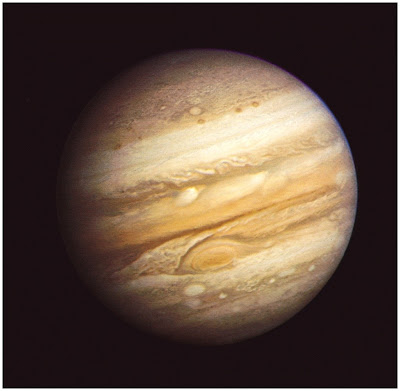
Beyond Our Planet - Planet Jupiter -1
Diameter of Jupiter = 88,846 Miles

Distance from Jupiter to the Sun = 460,000,000 miles at its closest and 508,000,000 miles at its furthest.

Distance from Jupiter to Earth = 365,000,000 miles at its closest.

One Rotation of Jupiter takes = 9 Hours 56 Minutes. Jupiters extreme rotation speed causes the planets shape to bulge at its equator. The diameter of Jupiter at its equator is about 7% larger than it is at the poles.

One Orbit around the Sun takes = 4,333 Earth days (almost 12 Years).

Atmosphere on Jupiter = 86% Hydrogen, 14% Helium, with very tiny amounts of methane, ammonia, phosphine, water, acetylene, ethane, germanium, and carbon monoxide

Speed of Travel during orbit = Approximately 29,236.75 MPH

Distance of Travel (one Orbit) = Approximately 3,040,387,928 Miles (Over 3 Billion Miles)

Rings = 3 Very thin Rings (Much fainter than the rings of Saturn).

Natural Satellites (Moons) = Jupiter has 16 satellites that are at least 6 miles in diameter, with many smaller ones. The four largest, known as the Galilean satellites, are - Io, Europa, Ganymede, and Callisto.

Other Notes = Jupiter has very little solid surface. Instead, it is a large ball of gas, its surface, a very dense layer of different colored clouds.

Jupiter has a large mass of swirling gas, known as the Great Red Spot, that spans 24,860 miles across (About 3 times the diameter of the Earth). The outer edge of the Great Red Spot travels at about 225 mph.

Jupiter's gravity is approximately 2.4 times stronger than on Earth. so something weighing 100 lbs on Earth would weigh 240 lbs on Jupiter.

Planet Mars

Mars is the fourth closest planet to the Sun

Beyond Our Planet - Planet Mars -1

Diameter of Mars = 4,214 Miles

Distance from Mars to the Sun = 128,390,000 miles at its closest and 154,860,000 miles at its furthest.

Distance from Mars to Earth = 33,900,000 miles at its closest.

One Rotation of Mars takes = 24 hours 39 minutes 35 seconds

One Orbit around the Sun takes = 687 Earth Days

Atmosphere on Mars = 95.3% Carbon Dioxide, 2.7% Nitrogen, 1.3% Argon, only .13% Oxygen, Carbon Monoxide .07%, Water Vapor .03%

Speed of Travel during orbit = Approximately 53,977.26 MPH

Distance of Travel (one Orbit) = Approximately 889,976,997 Miles

Wednesday, September 8, 2010

Planet Venus

Venus, is the second closest planet to the Sun


Beyond Our Planet - Planet Venus -1
Diameter of Venus = 7,522 Miles

Distance from Venus to the Sun = 67 Million Miles at its closest, to 68 Million miles at its furthest.

Distance from Venus to Earth = 25 Million Miles at its closest.

One Rotation of Venus takes = 243 Earth Days

One Orbit around the Sun takes = 224.7 Earth Days

Atmosphere on Venus = 96% Carbon Dioxide, 3+% Nitrogen, traces of Sulfur dioxide, water vapor, carbon monoxide, argon, helium, neon, hydrogen chloride, and hydrogen fluoride.

Speed of Travel
during orbit = Approximately 78,337.44 MPH

Distance of Travel (one Orbit) = Approximately 422,458,146 Miles

Sunday, September 5, 2010

Planet Mercury

Mercury is the closest planet to the sun

Beyond Our Planet - Planet Mercury -1
Diameter of Mercury = 3,032 Miles

Distance from Mercury to the Sun = 28,580,000 Miles at its closest, to 43,380,000 miles at its furthest.

Distance from Mercury to Earth = 48,000,000 Miles at its closest.

One Rotation of Mercury takes = 59 Earth Days

Sunrise to Sunrise on Mercury = 176 Earth Days

One Orbit around the Sun takes Mercury = 88 Earth Days

Atmosphere on Mercury = Mercury has very little in the way of gases in its atmosphere. From the planet, the sky would be black, even in the day. Some scientists think that you would even be able to see stars during the day.

Speed of Travel = Approximately 108,000 MPH

Distance Mercury Travels (1 Orbit) = Approximately 228,096,000 Miles

Friday, September 3, 2010

Planet Earth

The Earth is the third closest planet to the Sun

Beyond Our Planet - Planet Earth -1
Diameter of the Earth = 7,926 Miles

Distance from the Earth to the Sun = 91 Million Miles at its closest, to 94.4 Million miles at its furthest.

One full rotation of Earth takes = 24 hours (1-Day)

One complete Orbit around the Sun takes = 365 Days, 5 hours (1-Year)

Atmosphere = A mixture of 78% Nitrogen, 21% Oxygen, and 1% Other gases. The atmosphere is divided into 5 layers of which the clouds and most of the weather is found in the first layer.

Speed the Earth travels during its orbit = Approximately 66,000 MPH

Distance of Travel (1 - Orbit) = 583,400,000 Miles

Percentage of surface that is Land = 30%

Percentage of surface that is Water = 70%